 English
 Chinese (Traditional)
 French
 German
 Hindi
Hindi Italian
 Japanese
 Spanish
 Vietnamese
All Products

Triplett offers high-quality Earth Ground Resistance Testers that are essential for verifying electrical safety in industrial, commercial, and residential environments. These specialized instruments, also known as ground resistance testers or earth resistance test meter, accurately measure the resistance between grounding electrodes and the soil. They help ensure that grounding systems meet NEC, IEEE, and IEC safety standards, reducing the risk of electric shock, equipment damage, and fire hazards.
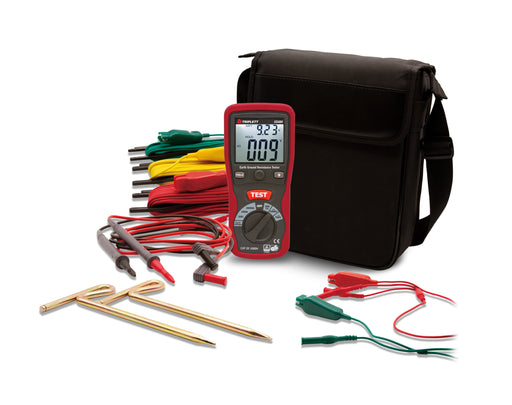
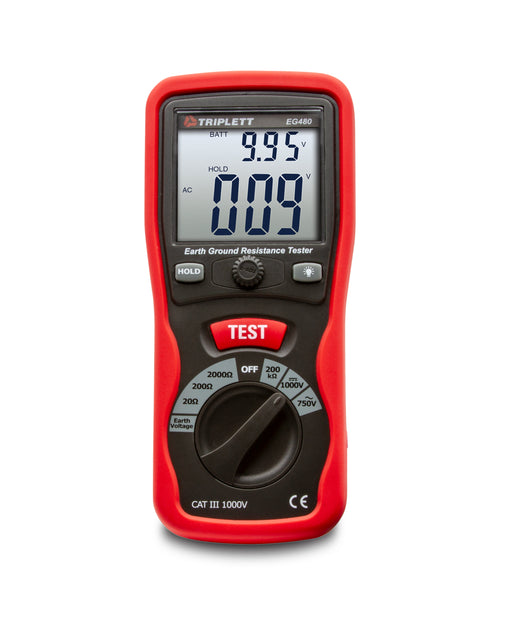
The Triplett Model EG480 can measure 2- and 3-wire Earth Ground Resistance (in 3 ranges) and Earth Voltage (200V), plus multimeter functions AC/DC ...
View full detailsGround resistance testing is a core practice in electrical installation and maintenance. It includes checking the resistance path between a grounding system and the earth, usually expressed in ohms. Resistance values depend on soil conditions, electrode depth, and local safety codes.
Using reliable earth ground resistance testers ensures these systems are checked against the right standards for each application.
Earth resistance testers operate on a simple but highly reliable principle. The device injects a small, controlled current into the earth through auxiliary test electrodes, while simultaneously measuring the resulting voltage drop. By applying Ohm’s Law (R = V/I), the Ground resistance tester calculates the resistance value of the grounding system in ohms.
This flexibility allows technicians to adapt the testing process to different soil conditions, installation sizes, and regulatory requirements.
Ground resistance testing or grounding tester is not just a technical formality-it is a critical component of electrical safety. Poor grounding can lead to dangerous conditions such as electric shock, equipment malfunction, fire hazards, and system downtime.
Here’s why it matters: -
Modern grounding testers are designed with advanced technology to deliver accurate, repeatable results in diverse field environments. Some key features include: -
Example: - At a telecom tower, technicians can use a clamp-on grounding tester to verify the integrity of the grounding system without interrupting network services, ensuring both safety and continuity.
Earth Ground resistance testers are versatile instruments used in multiple industries and environments:
Across these sectors, dependable ground testing equipment assures that systems are safe, efficient, and long-lasting.
Selecting the right earth resistance test meter depends on the specific requirements of your project or facility. Here are the main considerations:
By carefully evaluating these factors, professionals can select a grounding tester that delivers reliable performance, reduces testing time, and ensures compliance with industry standards.
A safe ground resistance is usually below 25 ohms for most facilities, while critical sites like hospitals and data centres may require 5 ohms or less.
Ground resistance should be tested at least once a year; high-risk locations may require more frequent checks.
2-wire testing is quick but less accurate, while 3-wire testing provides precise and reliable results, making it the industry standard.
Clamp-on testers are excellent for non-intrusive testing, but 3-wire fall-of-potential testing is still preferred for maximum accuracy.
They are commonly used by electrical contractors, utility companies, telecom engineers, healthcare providers, and industrial maintenance teams.
An earth resistance test meter measures the resistance between grounding electrodes and soil, ensuring systems meet safety codes.
It ensures safety and reliability, preventing electric shock, equipment damage, fire hazards, and costly downtime.